
The zero rate on qualifying domestic installations runs until 31 March 2027. After that, 5% applies. Not 20%, which is what most people assume. On ten panels with a 12kWh battery at £10,100, the difference works out at about £505.
✓ Five questions, about a minute, no obligation.
Most asked for, today
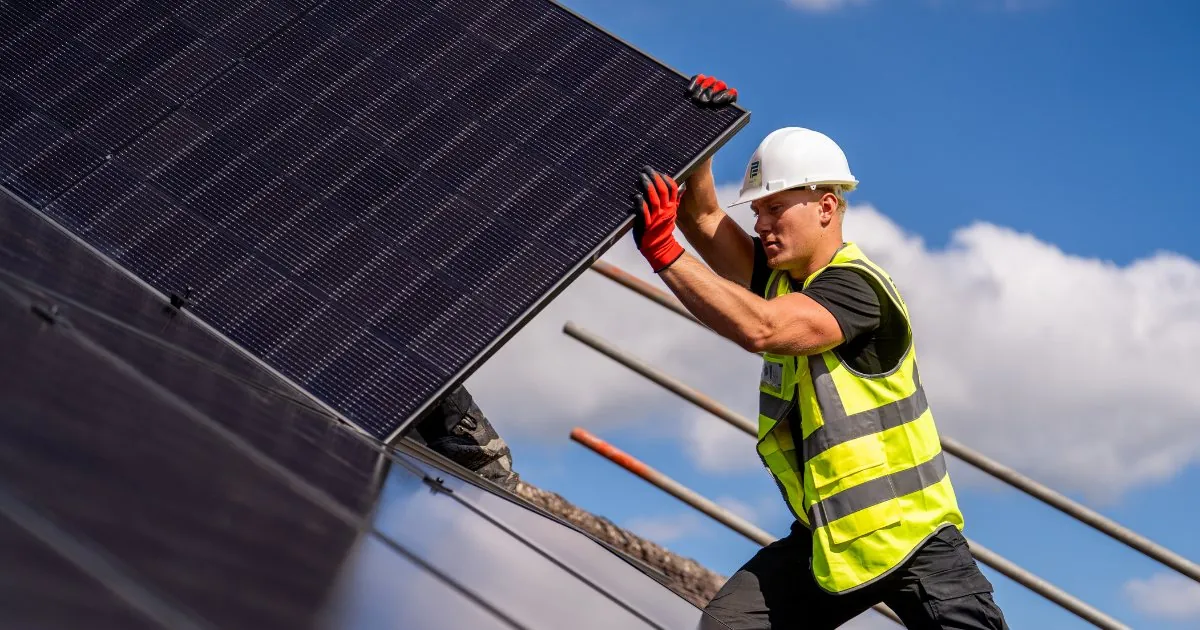
Ten DMEGC 465W panels with a 6kWh battery. About £425 more once 5% returns.
Fitted by Pro-Fit Green Energy, with access and the DNO notification handled by us.
In pounds
What 5% adds to each build.
Every guide price here has the zero rate applied already. The right-hand column shows roughly what the same installation would cost once 5% returns, at today's prices.
| Build | Price now, 0% VAT | Roughly what 5% adds |
|---|---|---|
| 6 panels, no battery | £6,000 | + £300 |
| 8 panels, 6kWh battery | £8,200 | + £410 |
| 10 panels, 12kWh battery | £10,100 | + £505 |
| 12 panels, 12kWh battery | £10,500 | + £525 |
Figures are rounded, and they rest on today's published guide prices for a standard pitched roof. Treat them as arithmetic about VAT, not a forecast of equipment costs in 2027. Your own price is fixed only after a free survey.
Capacity
The diary fills up before the deadline does.
Between now and 31 March 2027 there is a fixed number of installation days. Most people will leave it until the last few months. That is how deadlines work.
Weeks, not days
A solar installation is not a same-week job
Survey. Design. Ordering equipment. Booking access. Notifying your network operator. All of that sits between the day you say yes and the day panels go on the roof, and that is in a quiet month.
Bunched demand
Deadlines bunch demand
Access crews are finite. So is equipment supply, and so are our installation teams. Should half the county decide to be fitted in the first quarter of 2027, a good number of those jobs will land the wrong side of the deadline and pay 5%.
One fixed number
The VAT date is the only fixed date here
Legislation set 31 March 2027, so that date holds whatever anybody says about it. Everything else turns on your own property: what the roof takes, what your household uses, what your tariff pays. Your surveyor works those out on site and writes the assumptions beside every figure.
Relief ends
Then the reduced rate of 5% applies to qualifying installations.
From you
What we would need from you.
Four things. None of them onerous, and you can stop after any one.
- Your postcode and a rough idea of your usageEnough for an indicative price online in about a minute. Dig out a recent electricity bill if you have one handy, though it is not needed at this stage.
- About an hour for a surveySomeone has to see the roof, the loft, the consumer unit and the access with their own eyes. You are under no obligation at the end of it.
- Access to the loft and the meterThe two places a surveyor genuinely has to reach. If either sits behind a wardrobe or a lifetime of boxes, a bit of warning helps.
- A decision, in your own timeThe price is fixed and written down, and the contract carries 14 days to change your mind. Hesitating does not make it cheaper.
See a price for your roof before the rate changes.
Answer five short questions and a figure with the zero rate already applied comes back to you. Like it, and a survey fixes that figure properly. Dislike it, and you have spent a minute and signed up to nothing.
Sources and qualifiers
The small print on this page
The relief. A zero rate of VAT applies to the installation of qualifying energy saving materials, including solar panels and battery storage, in residential accommodation in Great Britain. The zero rate runs until 31 March 2027. From 1 April 2027 those installations revert to the reduced rate of 5%. They do not go to the standard rate of 20%.
The figures. The added amounts above are 5% of our current published starting prices, rounded. They hold the specification and the price steady, which makes them arithmetic about VAT and not a prediction of equipment costs. Whether a particular installation qualifies turns on the property and the work, and is confirmed at survey.
Your own figures. What a system generates depends on your roof, your usage and your tariff, so the figure comes after a survey, calculated using the standard industry method, with every assumption listed beside it for you to check.
In more detail
0% VAT on solar and batteries: what changes on 31 March 2027
What qualifies for the 0% rate
0% VAT on qualifying installations until 31 March 2027, then 5%. That is the headline, and it applies to the installation of energy-saving materials in residential accommodation across the UK: solar panels and battery storage are both on HMRC's qualifying list. So is insulation, heat pumps and a handful of other measures, but those are not what this page is about. The relief covers installation, not just the kit: buying panels with nobody fitting them does not qualify, and HMRC is explicit that a supply-only sale stays standard-rated.
The rate has been 0% in Great Britain since 1 April 2022. Northern Ireland joined on 1 May 2023, so the relief is now UK-wide, and HMRC's Notice 708/6 confirms it runs until 31 March 2027. From 1 April 2027 it reverts to 5%, the reduced rate that applied before 2022, not the standard 20% rate that some people assume will land. That distinction matters: mixing up 5% and 20% is a fifteen percentage point error on the price of the job.
A handful of conditions sit underneath the headline rate. The property has to be residential accommodation (a house, a flat, a park home used as a main residence and so on), and a few building types are excluded. None of that is unusual for a normal domestic installation, and it is confirmed at survey rather than guessed at online.
What 5% would add, in pounds
The table above, and our pricing page, already show every guide price with the 0% rate applied, so the figure you see today is the figure you would pay today. Nothing is added on top of it. Once the rate moves to 5%, the same specification would cost 5% more, assuming the cost of panels, inverters and batteries themselves does not change between now and then, which nobody can promise.
Take the six panel build with no battery as a short example. It is £6,000 installed under the current rate. Add 5% and the same build comes to roughly £6,300, an increase of about £300, which is the top row of the table above. The other rows work the same way: read off today's price, add 5%, and that is the arithmetic for that build.
Those are not a forecast and they are not a prediction of what panels will cost in 2027. They are the VAT arithmetic on today's published prices, done so you can see the actual pounds rather than a percentage sign. Your own price is fixed in writing only after a free survey, because a roof, a consumer unit and a loft are all things a surveyor has to see rather than assume.
Why booking early matters, and what it does not guarantee
Two separate clocks run on a solar job, and only one of them is in Pro-Fit's control. The first is ours: survey, design, ordering kit and booking an installation slot. The second is your network operator's, and it is slower.
Anything above roughly 3.68kW (16A per phase) needs what the industry calls a G99 application: your network operator (National Grid Electricity Distribution, SSEN or UK Power Networks, depending on where you live) has to approve the connection before export is confirmed. We cover what else sits inside that process, alongside scaffolding and the handover pack, on how it works. NGED's own published standard target for a low-voltage G99 application is 45 working days, and it says extensions beyond that are possible in constrained network areas, which it names as common in parts of the South West. We cannot promise which of those your postcode will get: some substations are more constrained than others, and that is down to the local network, not to us.
That is the honest reason to book with time in hand rather than in the last weeks before 31 March 2027. A property can often still be installed and self-consuming before export approval comes through, where the network operator allows it, and a battery means very little of that generation goes to waste while you wait. More on what else is covered in a build, and what isn't, is on our FAQ. What we will not do is promise you a specific date the network operator has not confirmed, or tie the VAT rate to a connection date nobody can guarantee.
Frequently asked questions
Does the 0% rate apply to batteries bought on their own, without new panels?
Yes. Electrical battery storage joined HMRC's qualifying list in its own right from 1 February 2024, whether it is installed alongside new panels or retrofitted to an existing solar system.
Will the rate definitely go to 5% on 1 April 2027 and not back to 20%?
That is what current legislation and HMRC's Notice 708/6 say, and 5% was the rate before the 2022 zero-rating, so it is a return to a known rate rather than a new one. A Budget or Finance Bill could change it before the date arrives, which is exactly why this page carries a recheck note against the 28 October 2026 Budget.
Does the VAT rate change what Pro-Fit includes in a build?
No. The specification, the scaffolding, the bird protection, the monitoring app and the handover pack are the same regardless of which VAT rate applies. Only the rate charged on the labour and materials changes.
Can I get a fixed price now and have it honoured after 31 March 2027?
Your written quotation fixes the specification and the price for the validity period stated on it, and your surveyor will talk you through what it covers. How the VAT element is handled if your installation date falls after the rate changes is confirmed at that stage rather than on this page.
Does a flat roof or an unusual roof type change whether I qualify?
No, qualification turns on the property being residential accommodation and the work being an installation of energy-saving materials, not on roof type. Roof type affects what we specify and how we mount it, which is a separate conversation at survey.
What if my network operator takes longer than 45 working days?
Then it takes longer, and we tell you as soon as we know rather than guessing. Export approval and the VAT deadline are two different clocks, and a delay on one does not move the other.
Sources
- GOV.UK, HMRC Notice 708/6: VAT on energy-saving materials and heating equipment, read 7 October 2026 (https://www.gov.uk/guidance/vat-on-energy-saving-materials-and-heating-equipment-notice-7086)
- solarbypostcode.co.uk, "DNO G98 vs G99 export limits UK" (the 3.68kW/16A per phase threshold), read 7 October 2026 (https://solarbypostcode.co.uk/guides/dno-g98-g99-export-limits-uk/)
- SurgePV, NGED compliance and connection timescales page (the 45 working day standard target and South West extension note), read 7 October 2026 (https://www.surgepv.com/solar-compliance/uk/dnos/nged)